
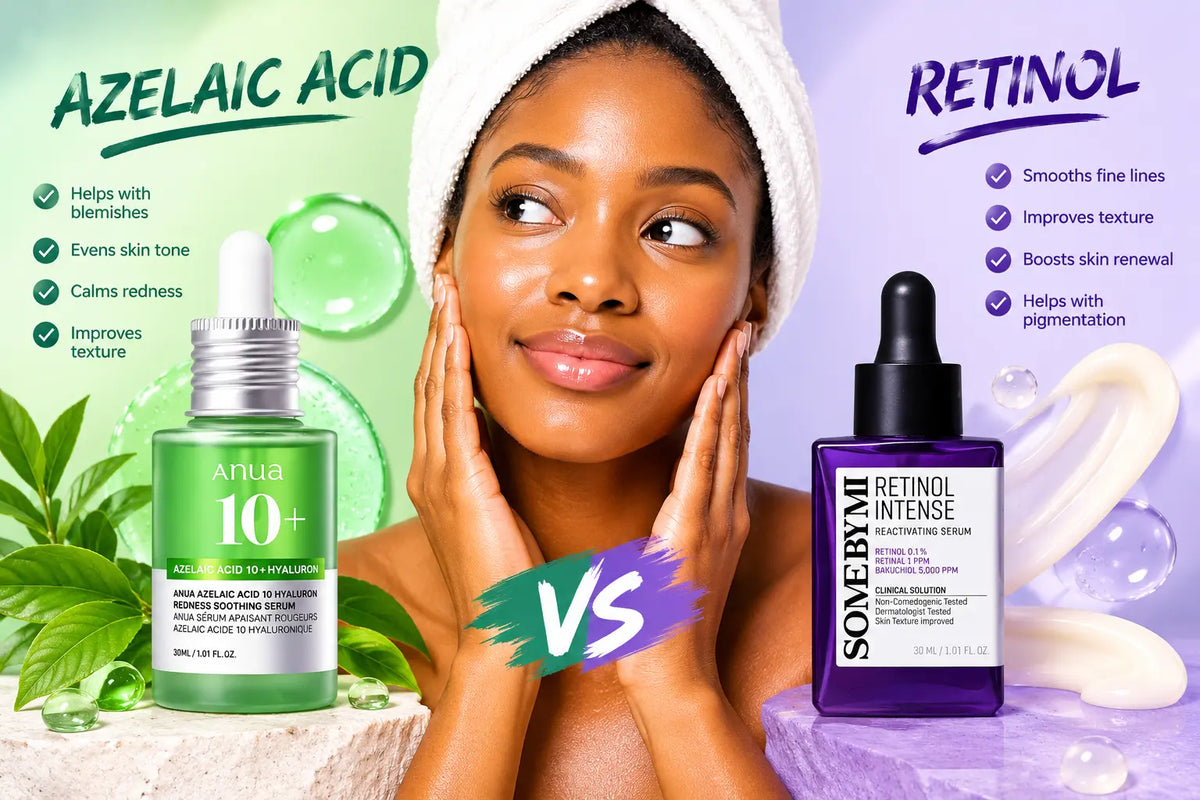
AZELAIC ACID VS RETINOL: WHICH SKINCARE INGREDIENT IS RIGHT FOR YOU?
AZELAIC ACID VS RETINOL: WHICH SKINCARE INGREDIENT IS RIGHT FOR YOU?
Two skincare ingredients constantly make their way into conversations about clearer, smoother, more radiant skin: azelaic acid and retinol.
Both can help improve the appearance of uneven skin tone, blemishes and texture, but they work in very different ways. So, which one should you add to your routine?
The answer depends on your skin concerns, skin sensitivity and what you want to achieve.
Let’s break down the difference between azelaic acid and retinol so you can choose the ingredient that makes the most sense for your skin.
WHAT IS AZELAIC ACID?
Azelaic acid is a naturally occurring dicarboxylic acid that has become a skincare favourite for its versatility.
It is particularly popular among people dealing with blemishes, redness, uneven skin tone and post-breakout marks.
Unlike some powerful active ingredients that can feel harsh, azelaic acid is generally considered a more gentle option and can be suitable for many different skin types.
WHAT DOES AZELAIC ACID DO?
Azelaic acid can help:
- Reduce the appearance of blemishes
- Improve the appearance of post-acne marks
- Even out the look of skin tone
- Calm the appearance of redness
- Refine the appearance of uneven texture
- Support clearer-looking skin
- Help reduce the appearance of hyperpigmentation
One of its biggest advantages is that it can target multiple concerns at once, making it a useful ingredient for a simple skincare routine.
WHAT IS RETINOL?
Retinol is a form of vitamin A and belongs to a family of ingredients called retinoids.
It is best known for supporting skin renewal and improving the appearance of fine lines, uneven texture, pigmentation and blemishes.
Retinol works by influencing skin-cell turnover and biological processes within the skin, which is why it is often included in routines focused on long-term skin texture and signs of ageing.
WHAT DOES RETINOL DO?
Retinol can help:
- Improve the appearance of fine lines
- Smooth uneven-looking texture
- Improve the appearance of pigmentation
- Support clearer-looking pores
- Reduce the appearance of blemishes
- Promote a smoother, more refined-looking complexion
- Support firmer-looking skin over time
However, retinol can also cause dryness, peeling, redness or irritation, particularly when you first introduce it or use a concentration that your skin isn't accustomed to.
AZELAIC ACID VS RETINOL: THE BIG DIFFERENCE
While both ingredients can be used for acne, pigmentation and uneven texture, they approach these concerns differently.
| Azelaic Acid | Retinol | |
|---|---|---|
| Main category | Dicarboxylic acid | Vitamin A derivative |
| Best known for | Blemishes, redness & uneven tone | Texture, fine lines & skin renewal |
| Helps with pigmentation | Yes | Yes |
| Helps with blemishes | Yes | Yes |
| Helps with redness | Particularly useful | May cause temporary redness/irritation |
| Fine lines | Indirectly supports overall skin appearance | Stronger focus |
| Skin sensitivity | Often better tolerated | Can be more irritating |
| Beginner-friendly | Generally | Requires gradual introduction |
| Best for | Uneven tone, blemishes & redness | Texture, ageing concerns & blemishes |
WHICH IS BETTER FOR ACNE?
Both can be useful for acne-prone skin, but they have different strengths.
Azelaic acid can be a great choice if your acne routine also needs to address redness and post-acne marks.
Retinol may be useful when your main concerns include clogged pores, blemishes and uneven skin texture, while also wanting to address signs of ageing.
If your skin is easily irritated, starting with a gentler active may make sense before introducing a stronger routine.
WHICH IS BETTER FOR DARK SPOTS?
Both ingredients can help improve the appearance of pigmentation, but azelaic acid is especially popular in routines targeting post-inflammatory hyperpigmentation and uneven skin tone.
Retinol can also support a more even-looking complexion by encouraging skin renewal.
For people whose main concern is dark marks left after breakouts, azelaic acid may fit naturally into a targeted routine.
And remember: daily sunscreen is essential when working on pigmentation. Without consistent sun protection, dark marks can remain stubborn and new pigmentation can develop.
WHICH IS BETTER FOR SENSITIVE SKIN?
This is where the difference becomes particularly important.
Azelaic acid is generally considered to have a more manageable irritation profile than retinol, although any active ingredient can cause irritation in some people.
Retinol can initially cause:
- Dryness
- Flaking
- Redness
- Tightness
- Increased sensitivity
This doesn't necessarily mean retinol is unsuitable for you. It means it should generally be introduced slowly and carefully.
If your skin barrier is already stressed, introducing several strong actives at the same time can make irritation more likely.
CAN YOU USE AZELAIC ACID AND RETINOL TOGETHER?
Yes, they can be incorporated into the same overall skincare routine, but that doesn't mean you need to apply both at the same time.
If you're new to active ingredients, introducing them gradually is a smarter approach.
For example:
MORNING
Cleanser → Azelaic Acid → Moisturizer → Sunscreen
EVENING
Cleanser → Retinol → Moisturizer
This approach separates the actives and gives your skin a chance to adjust.
However, not everyone needs both. A skincare routine should be built around your individual concerns rather than collecting as many active ingredients as possible.
AZELAIC ACID OR RETINOL: WHICH ONE SHOULD YOU CHOOSE?
CHOOSE AZELAIC ACID IF…
Your main concerns are:
✔ Post-acne marks
✔ Uneven skin tone
✔ Redness
✔ Blemishes
✔ Sensitive or easily irritated skin
✔ A simpler active-ingredient routine
CONSIDER RETINOL IF…
Your main concerns are:
✔ Fine lines
✔ Uneven texture
✔ Signs of ageing
✔ Clogged pores
✔ Blemishes
✔ A more intensive skin-renewal routine
WANT TO TARGET MULTIPLE CONCERNS?
You don't necessarily have to choose one forever.
Many skincare routines can incorporate different active ingredients at different times, provided your skin tolerates them and you introduce products gradually.
The key is consistency, not complexity.
THE GLOW SECRET PICK: AZELAIC ACID
If you're looking for an ingredient that can fit into a routine focused on blemishes, redness, uneven tone and post-breakout marks, azelaic acid is worth exploring.
One option is the Anua Azelaic Acid 10 Hyaluron Redness Soothing Serum, formulated with azelaic acid alongside hydrating ingredients.
It can be a particularly appealing choice when you want to work on uneven-looking skin while keeping hydration and comfort in your routine.
DON'T FORGET YOUR SUNSCREEN
Whether you're using azelaic acid, retinol or both, sunscreen should be a non-negotiable part of your daytime routine.
UV exposure can contribute to pigmentation, premature signs of ageing and uneven skin tone. A broad-spectrum sunscreen helps protect your skin while you're working towards a more even, healthy-looking complexion.
THE FINAL VERDICT
Azelaic acid and retinol aren't really competitors — they're different tools for different skincare goals.
Azelaic acid shines when your focus is blemishes, redness, post-acne marks and uneven skin tone.
Retinol is particularly well known for supporting smoother-looking texture, skin renewal and reducing the appearance of fine lines.
And sometimes, your routine may benefit from both.
The best skincare routine isn't necessarily the one with the most powerful ingredients. It's the one you can use consistently, comfortably and correctly.
READY TO CHOOSE YOUR ACTIVE?
Start by identifying your biggest skin concern. If it's redness, blemishes and post-acne marks, azelaic acid may be a great place to start. If it's fine lines, texture and skin renewal, retinol may be worth exploring.
Whatever you choose, introduce active ingredients gradually, moisturize regularly and never skip your daytime sunscreen.



Leave a comment
This site is protected by hCaptcha and the hCaptcha Privacy Policy and Terms of Service apply.